G-EMV: Emotion and Reason in an Agent. Curiosity, Trust and CommitmentG-EMV: emoción y razón en un agente. Curiosidad, confianza y compromiso
Independent researcher, BarcelonaInvestigador independiente, Barcelona
This work observes and tests an artificial creature made of two parts. A body that feels what it lacks in three dimensions, its body, its resources and its bonds: what that body feels is what we call emotion here. And beside it a head that talks, a language model that advises it: that is reason. The question is when thinking is of use to a body like this.
Este trabajo observa y pone a prueba a una criatura artificial hecha de dos partes. Un cuerpo que siente lo que le falta en tres dimensiones, su cuerpo, sus recursos y sus vínculos: lo que ese cuerpo siente es lo que aquí llamamos emoción. Y a su lado una cabeza que habla, un modelo de lenguaje que le aconseja: eso es la razón. La pregunta es cuándo le sirve pensar a un cuerpo así.
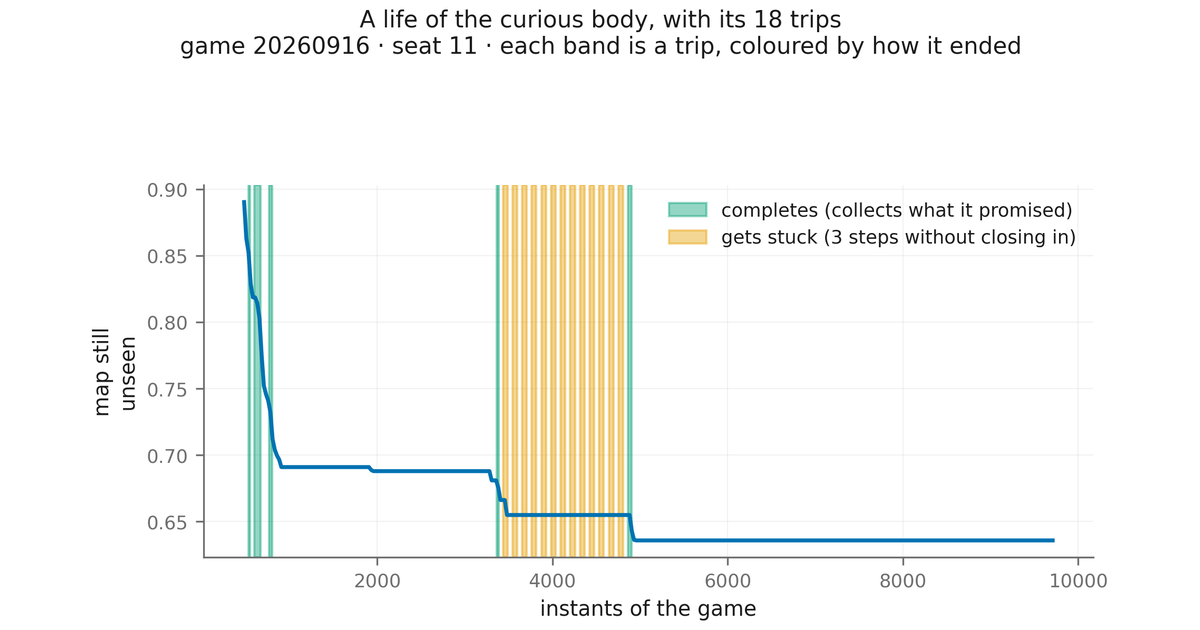
To answer it we give the world time, with games twice as long, and we build three pieces. The first is a wide door: the advisor no longer proposes a step, but a whole plan with its emotional shape, what the body will feel on each leg of the way, and the body judges it with its own table. This door tells good advice from random advice, something the earlier one did not do; but, so as not to fool itself, it can only judge the small part of the good that the body is able to foresee. The second is trust, which is earned and lost with results: in the tests, an advisor that talks at random soon loses trust and stops moving the body with good news. The third is curiosity, installed as one more need of the body. As a nudge at each step it did not work. As a trip with a destination and commitment it did: while it travels, the body discovers almost six times more world per instant than when it is not traveling, without getting closer to danger; since it travels little, over the whole game it sees 16% more of the map than the body alone (31% on the stretches where no step was lost; section 10).
Para responderla le damos tiempo al mundo, con partidas el doble de largas, y construimos tres piezas. La primera es una puerta ancha: el consejero ya no propone un paso, sino un plan entero con su forma emocional, lo que el cuerpo irá sintiendo en cada tramo del camino, y el cuerpo lo juzga con su propia tabla. Esa puerta distingue un consejo bueno de uno al azar, cosa que la anterior no hacía; pero, para no engañarse, solo puede juzgar la pequeña parte de lo bueno que el cuerpo es capaz de prever. La segunda es la confianza, que se gana y se pierde con resultados: en las pruebas, un consejero que habla al azar pierde pronto la confianza y deja de mover al cuerpo con buenas noticias. La tercera es la curiosidad, instalada como una necesidad más del cuerpo. Como empujón en cada paso no funcionó. Como viaje con destino y compromiso sí: mientras viaja, el cuerpo descubre casi seis veces más mundo por instante que cuando no viaja, sin acercarse al peligro; como viaja poco, en toda la partida ve un dieciséis por ciento más de mapa que el cuerpo solo (un treinta y uno por ciento en los tramos en que no se perdió ningún paso; sección 10).
In a hundred games, the advisor's plans gave the body no advantage at all. Almost all the improvement in the creature's future goes through the others, and what they will do the body cannot foresee. What the work leaves is the division of roles that makes reason useful: the body says what it needs and, therefore, what is worth knowing; reason can say where to find it; and the body checks it, commits to the plan and only lets go of it if something important happens.
En cien partidas, los planes del consejero no le dieron ninguna ventaja al cuerpo. Casi toda la mejora del futuro de la criatura pasa por los otros, y lo que ellos harán el cuerpo no lo puede prever. Lo que el trabajo deja es el reparto que hace útil a la razón: el cuerpo dice qué necesita y, por tanto, qué vale la pena saber; la razón puede decir dónde encontrarlo; y el cuerpo lo comprueba, se compromete con el plan y solo lo suelta si pasa algo importante.
Everything was measured in a single world, private and with chosen neighbors, and without the creature learning from one game to the next.
Todo se midió en un solo mundo, privado y con vecinos elegidos, y sin que la criatura aprenda de una partida a otra.
Read on ZenodoLeer en ZenodoLeer en español (PDF)
Paper five: second part of the series on emotion and reason in an agent. Concept DOI (all versions): 10.5281/zenodo.23035784. Code, reports and data: github.com/Manelenrico/g-emv/paper5.
Trabajo cinco: segunda parte de la serie sobre emoción y razón en un agente. DOI de concepto (todas las versiones): 10.5281/zenodo.23035784. Código, informes y datos: github.com/Manelenrico/g-emv/paper5.